
What rope for macrame?
Table of contents
Macramé is a traditional braiding technique that involves making various successive knots. It can be used to create home decor, jewelry, or hangers.
Micro-macramé should be distinguished from macramé.
Micro-macramé means "tiny"
The knots used are the same, but one is used for making jewelry and the other for decorations or making hammocks, for example. The difference lies in the size of the threads used.
For micro-macramé, Linhasita thread, a Brazilian brand of natural rope, is ideal for making jewelry. It is one of the most well-known threads in the world, offering a wide range of colors and three different diameters, from 0.5 mm to 1 mm.
This polyester thread has the advantage of being pre-waxed, which will help your knots stay in place and not slip.
But you can also use other fine threads like cotton thread, wool, plastic lace, beading wire, silk thread, etc.

Macramé rope
Macramé thread is more like rope because, in fact, the thread will be thicker than for micro-macramé.
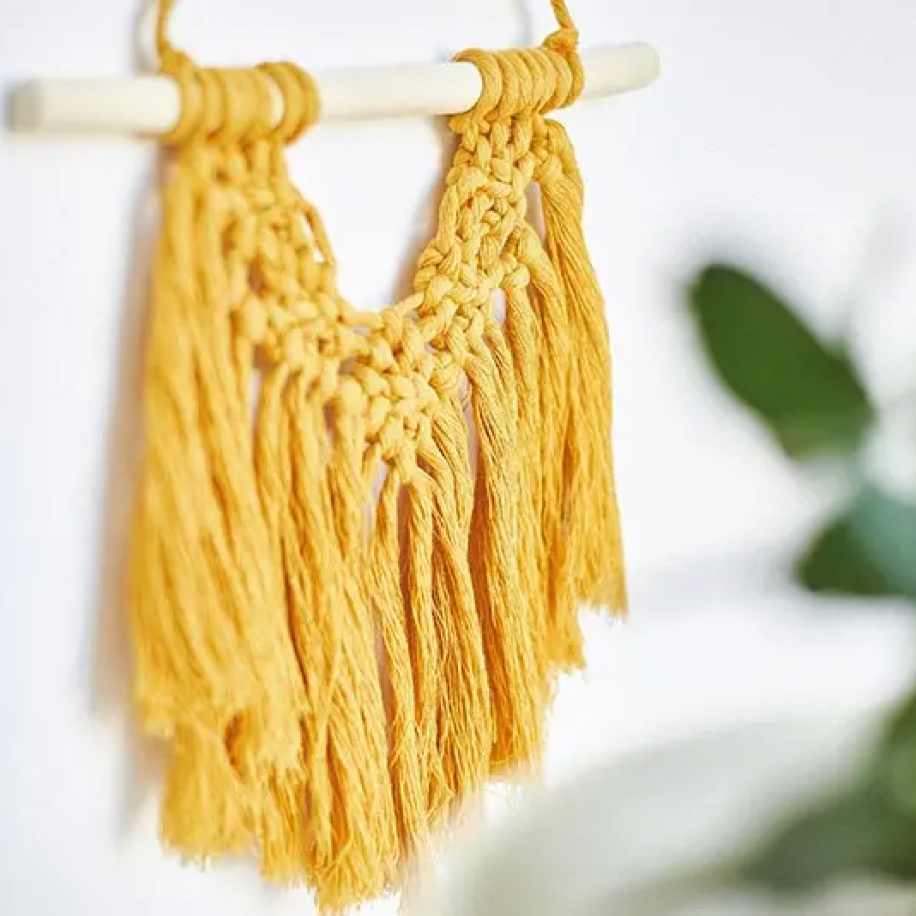
A 3mm cord is more suitable for making a plant hanger or a macramé wall hanging, for example.
The most common are 3mm and 5mm for twisted ropes, while for single-strand combed ropes, you can easily go up to 8 or 10mm.
To get started in macramé and choose the right thread for you, cotton rope is perfect: sold by the meter or in spools, made of natural textile fibers, available in several colors, easy to handle... You will be able to easily start your first macramé creations.
Combed cottons being more flexible and less dense, you can choose a wider diameter than for twisted cottons, which will already be quite imposing at 5mm.
You can consider cotton cord spools or jute twine.

To undertake a macramé project, you need materials.
It is an activity that does not require many tools.
You will need: either macramé rope or thread for micro-macramé, depending on your project. You will also need a tray support, a pair of scissors, a tape measure, pins with heads, and beads or gemstones for a more aesthetic touch.
How to do macramé?

Nothing could be simpler, there are different knots to use for this technique, you just need to know them:
- The square knot: which is the basic knot
- The Chinese knot: which is formed by two loops and resembles a pretzel
- The cordage knot: the working thread is twisted twice around the carrier thread to form a double knot.
There are still other knots. Feel free to watch different tutorials online!