


Why a halyard can slip in a winch?
Table of contents
You have just changed your halyard and get a nasty surprise: it does not hold well in the clutch or winch.
Here are a few ideas to solve your problem.
Check the rope diameter
To avoid mistakes when replacing the halyards and sheets on your sailboat, the simplest approach is to buy ropes identical to the original ones.
Because when it leaves the manufacturer, the boat is designed to be able to sail correctly.
Check your deck hardware as well as the old rope, and ensure that the newly purchased halyard indeed has the same diameter as the old one.
If the original rope on the boat was 10mm polyester, then get 10mm polyester again.
If you have bought a halyard with a diameter that is too small, it may not be well suited to your deck hardware.
Adding a cover to the halyard
Replacing a worn rope with a more technical one can be tempting or even beneficial depending on your use and sailing style.
A Dyneema halyard has many advantages and is a very technical product, ideal for those seeking performance and feel at sea.
Since Dyneema has a very high breaking load, one might look to reduce the diameter of the rope while remaining within the constraints of the clutches.
However, while high-modulus polyethylene has the advantage of being very resistant to abrasion, it is also a more slippery material than polyester.
And when it comes to clutches, a smooth and slippery fiber is not ideal.
The solution is quite simple: add a cover to the halyard with a polyester sleeve, of the same diameter as the rope, of course.
Polyester has a much higher coefficient of friction and will compensate for this lack of grip in the clutches.
This way, you get the best of both textile fibers: the lightness, abrasion resistance, breaking strength, and high performance of Dyneema along the majority of the halyard's length, while optimizing the hold in the clutches by using polyester only where it is truly necessary.
Check the winch
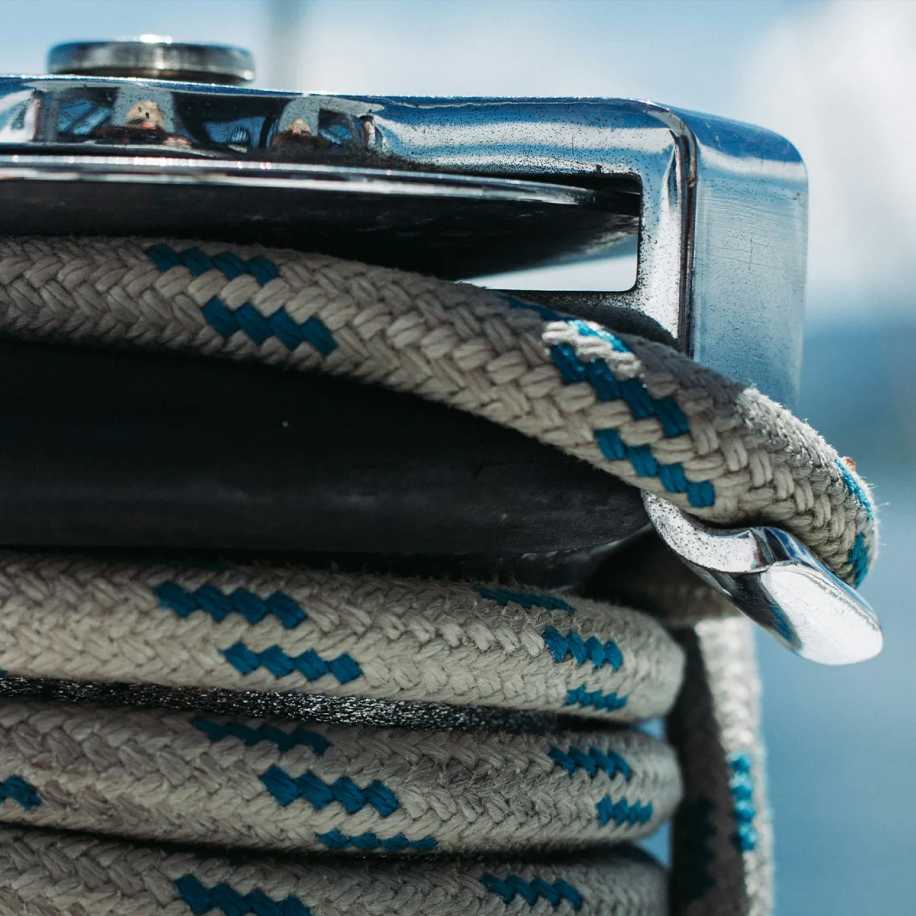
Remember to check the wear on the winch drum.
Like any element on a sailboat, deck hardware is subject to UV rays, friction, salt... in short, it eventually wears out over time.
If the winch drum is worn (this is the part in contact with the rope), there is less friction and your halyard may slip.
This is also true for clutches, which wear out quickly.
When new, deck hardware is often rated with a margin of plus or minus 1 in diameter. Obviously, once the equipment has been used a bit and starts to wear down, this is no longer true.