


What support to install a hammock net
Table of contents
Are you looking to install a residential net and wondering if the project is feasible in your home?
The first essential thing to check: the support on which you will place the net. This must be sufficiently strong for optimal safety.
Find all our advice in this guide.
Installing a mezzanine net
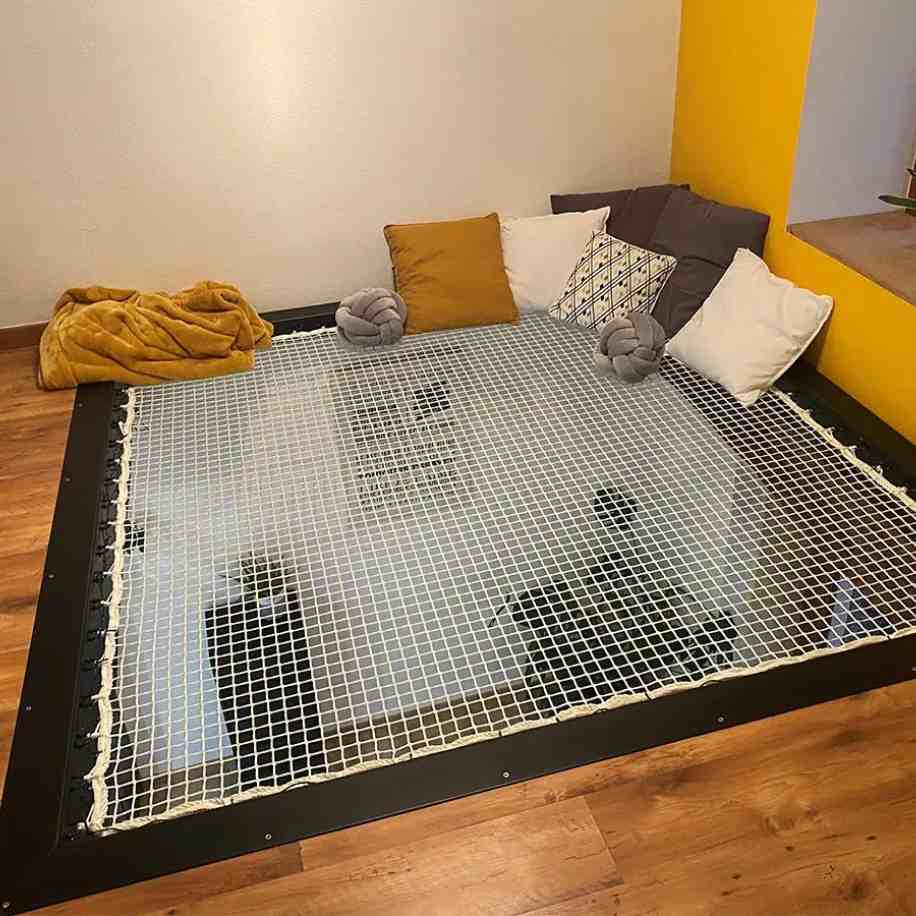
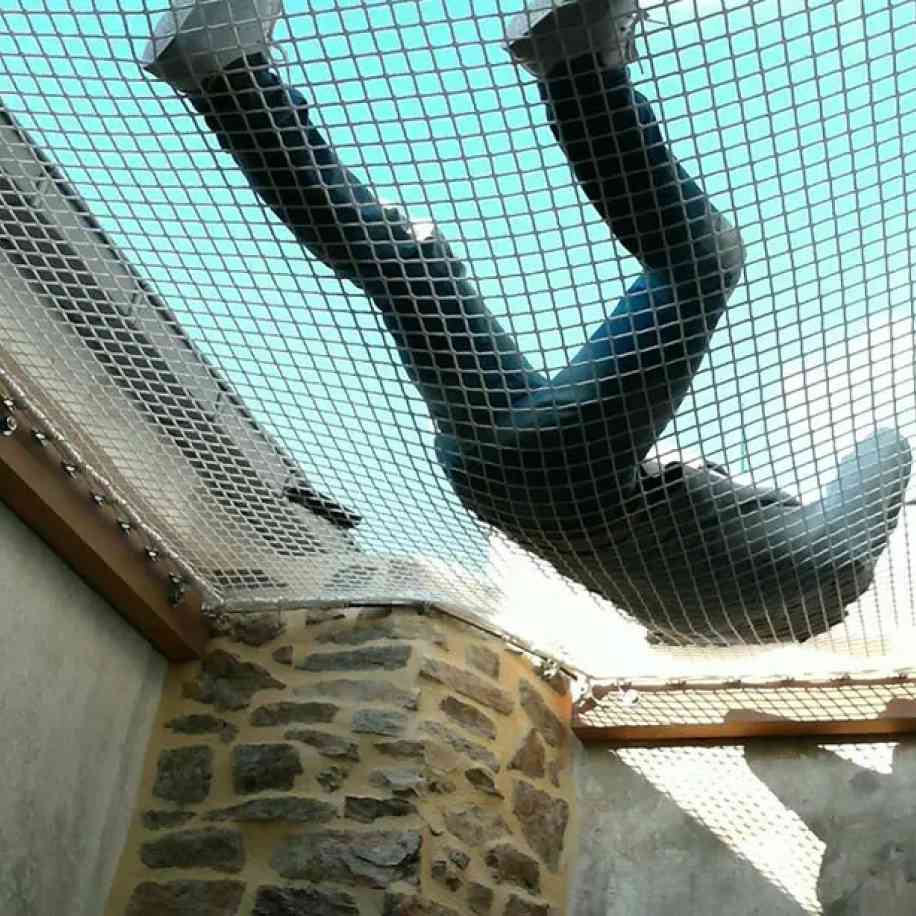
A catamaran net installed horizontally becomes a mezzanine, a real openwork and suspended floor, on which children and adults can walk and lie down.
This mezzanine net must therefore be securely fixed all around its perimeter, whatever its shape: square, triangle, rounded... no edge can remain unfixed.
You can see on social networks, decor blogs, and elsewhere, images of nets used like a giant hammock, forming a large hollow, sometimes even with unfixed edges. With this type of installation, the design effect might be there, but not the safety. We strongly advise against such an installation.
If the void you wish to fill does not have a solid structure all around its perimeter, then you will need to add one, for example by installing a beam.
We will come back to this later in this article.
Installing a guardrail net
For installing a guardrail net, both indoors and outdoors (balcony, terrace, stairwell...), it must also be fixed, ideally, on all sides.
The constraints for fixing a guardrail net depend on its dimensions and its location: for a stairwell or a balcony, the installation is not the same.
However, our recommendations are less demanding for this product: it can be fixed to the balcony floor, for example, or to a wooden railing... The force exerted on the mesh (and therefore the supporting structure) is less significant than for a mezzanine net, which fully supports the weight of one or more people.
For a balcony or a terrace, the guardrail must be securely fixed to the ground and on the sides.
The upper part, in the absence of complete fixing, can be left unsupported provided the net is more than 90 cm high.
It is also possible to use a textile cable to attach one side of the net, after carefully studying the location and intended use.
Our team advises you on these technical questions.
Standards and safety
There is a French standard NF EN 1263, which defines safety requirements for fall protection nets found in construction and public works.
However, the use, manufacture, and very purpose of residential nets are completely different. Also, for catamaran nets used as mezzanines, there is currently no French standard. Neither for the manufacture of the net itself nor for its installation method.
Nevertheless, at Corderie Gautier, we have over 20 years of experience in designing and installing residential nets and catamaran nets. Our products have even been tested and certified with a resistance of up to 700 kg / m ² for horizontal installation, and 400 kg / m ² for guardrails.
To achieve this level of safety, the quality of the net's design is, of course, paramount. But the installation and the choice of materials are just as important!

The same applies to guardrail nets, which do not meet an established standard for these indoor nets. However, we draw inspiration from the fall protection standard, as well as our long experience, to recommend a product and a fixing method that make your installation safe.
Recommended materials
For installing your residential net in the house or garden, we strongly recommend using solid materials:
- Wooden beam
- Steel beam (IPN) or tube
- Solid concrete block
- Concrete
- Stainless steel tube
These are truly the materials to prioritize. They are indeed very resistant and can easily withstand significant tensile force.
Wooden beam
It is entirely possible to install a mezzanine net on a wooden structure, regardless of the wood species used.
- If the wooden beam is backed against and securely fixed to a wall, then we recommend a minimum wood thickness of 80 mm.
- If the wooden beam, on the other hand, is not backed against a wall and fully supports the load, then we recommend a section with a minimum thickness of 140 mm.
IPN Steel, Aluminum, or Stainless Steel Beam
The choice to fix your residential net to an IPN beam (I-section Parallel Flange) is an excellent idea.
An IPN is used in building construction or renovation to reinforce the structure with reduced weight: so to support a net and the weight of a person, it's perfect.
For aluminum or stainless steel beams, or steel IPN, we advise you to consult a building professional for the sizing and installation of the beam. Construction is a skilled trade!
Solid concrete block and concrete
For solid concrete blocks and concrete, these materials are very resistant. Such a configuration means that you are fixing the net by drilling directly into a wall or a concrete slab: robustness is therefore not a problem.
Note that you will need appropriate anchors for your project, which you can find in specialized DIY stores or by asking a craftsman to perform the installation.
Materials not recommended
In many situations, we do not recommend fixing a residential net at all if the material is not strong enough. This is essentially true for all hollow and friable materials:
- Plasterboard (placo or BA13)
- Hollow brick
- Hollow concrete block
- Natural stone wall
For solid brick, such an installation is possible, but we do not recommend fixing the net to this support.
If the structure on which you plan to install your mezzanine net is made of one of these materials, then you will need to reinforce the entire structure by installing beams, securely fixed to the walls, or reconsider the location of the custom-made catamaran net.
For all your projects, our team is available to guide and advise you. Contact us from the design stage to ensure you make the right choices.