


Products
Instructions for Use
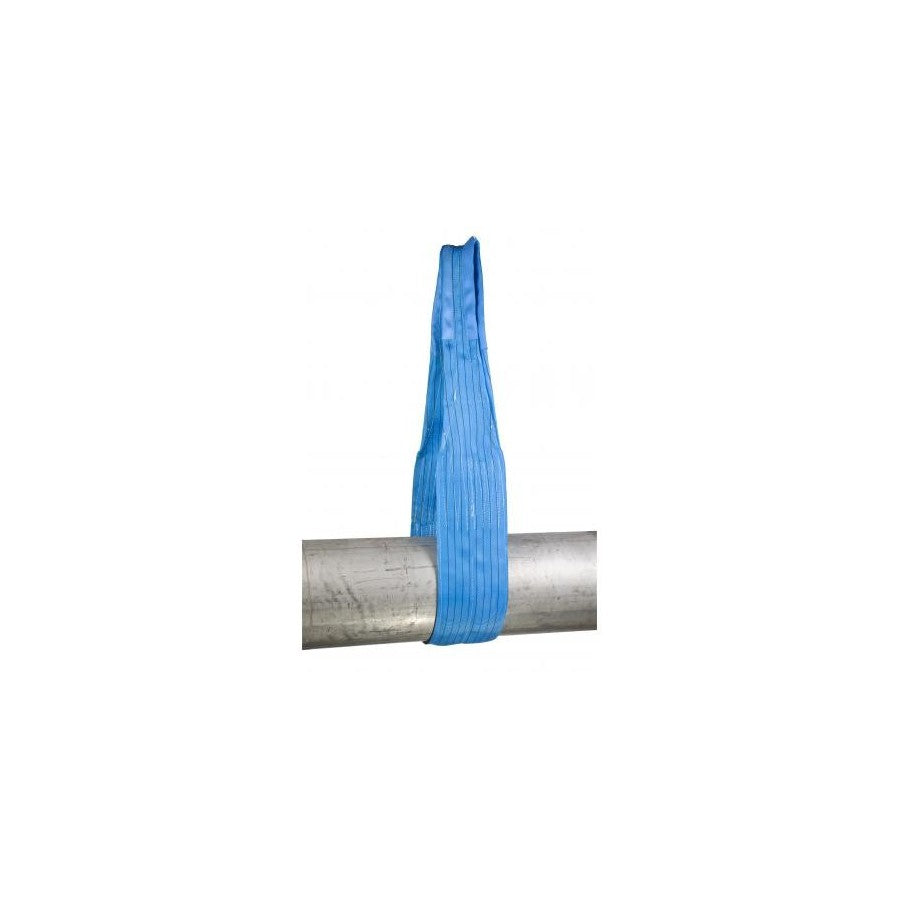
At Corderie Gautier, you will find round and flat lifting slings made of polyester.
Polyester has the advantage of being rot-proof and weather-resistant.
Here are some safety instructions for using these lifting accessories when lifting and transporting loads:
- Do not knot or twist
- Do not use on sharp edges (provide protection)
- Do not overload and refer to the label
- Operating temperature between -40°C and +100°C
- Do not use at an angle greater than 60°
- Do not pass under the load
What is a textile lifting sling?
A lifting sling is an accessory that connects a load to be lifted to a lifting device: hoist, crane, spreader bar, etc.
It can be made of a chain, rope, cable, or, as in this case, a textile material.
It is an essential component of lifting operations.
Its lower end usually terminates in a lifting or rigging accessory: shackle, ring, lifting hook.
As for the upper end, stainless steel rings can be found due to their resistance to corrosion and humidity, hooks, or even a specially made loop.
All components (sling, lifting hook, shackle, hoist, etc.) constitute your lifting system.
Round or flat textile sling
Textile slings are made from synthetic fibers.
We primarily offer two types of accessories for your rigging operations: round textile slings (also known as tubular or endless slings) and flat slings.
Each type can support loads from 1 to 10 tons, in accordance with their color, use, and European standard.
Chain, wire rope, or textile slings: each main type of sling has its advantages and disadvantages, depending on your use.
Textile lifting straps have the advantage of being very flexible, which greatly facilitates their use and allows you to find a solution for lifting complex-shaped loads.
Lightweight, they are easy to transport and handle: the lifting operation is less strenuous for the worker. This is without compromising the load, as they can lift up to 10 tons.
The textile sling is also preferred for lifting fragile loads that could be damaged by a chain or wire rope.
There are 3 textile fibers used to manufacture these lifting accessories:
- Polyester
- Polyamide
- Polypropylene
At Corderie Gautier, we only sell polyester slings.
Flat lifting strap
This is a flat sling with two loops, one at each end, to facilitate attachment and lifting or pulling operations.
The ends of the flat strap are sewn to form loops folded back on themselves to better fit the lifting hook, and reinforced with protection. The strap is entirely composed of textile fibers: at Corderie Gautier, it is polyester.
These flat lifting straps are reusable, provided, of course, that the maintenance and safety rules for using this accessory are always respected.
Very light and compact, the flat lifting strap, due to its manufacturing method and composition, is more compact than a round sling, with good abrasion resistance.
Due to its shape, thinness, and ease of adaptation to the lifted load, the flat lifting strap is particularly suitable for non-rounded loads: stone, concrete block, pallet, etc.
Textile sling standard
Textile slings, regardless of their shape or material, must comply with a European Standard, a guarantee of quality and safety.
At Corderie Gautier, we offer a selection of textile slings that comply with Standard EN 1492, which comes in two forms:
- Standard EN 1492-1 for flat slings
- Standard EN 1492-2 for round textile slings
Each product is marked with a clearly identifiable label (or marking ring), the presence of which is mandatory.
What mandatory information must a textile sling display?
The label is an element that guarantees the traceability of your lifting accessory and includes all mandatory information for safe use.
If your textile sling does not have a label, it is strongly recommended not to use it and/or to seek advice from your professional seller.
Several elements inscribed on the label, in text or pictogram form, are mandatory and aid in inspection.
These include: the manufacturer or reseller, the WLL, the manufacturing date, the EN standard, the CE standard, the batch number or individual product number, the length, and the mode factor (i.e., geometry and use with angles).
What is the WLL of a sling?
WLL stands for Working Load Limit.
This is therefore the maximum load that a sling or lifting strap can lift safely and should never be exceeded.
For textile lifting slings, both round and flat, a color code allows for very easy and quick identification:
- Violet = 1 ton
- Green = 2 tons
- Yellow = 3 tons
- Gray = 4 tons
- Red = 5 tons
- Brown = 6 tons
- Blue = 8 tons
- Orange = 10 tons
Note that with a round sling, it is possible to lift up to 100 tons. The color code will always be orange.
The flat lifting strap is more limited.
Other factors must be taken into account and can vary the WLL: angles, rigging geometry, etc.
It is therefore imperative to refer to the label and the manufacturer's instructions to incorporate the mode factor into the WLL calculation.
The safety factor for textile slings and flat lifting straps is 7.
While this information must be displayed and communicated, it does not in any way affect the calculation of the supported load.
A sling with a WLL of 1 ton and a breaking coefficient of 7 does not authorize lifting a load of 7 tons. It remains 1 ton in direct attachment.
How to identify a sling or lifting strap?
As mentioned previously, each sling or flat lifting strap is manufactured in a specific color that corresponds to a Working Load Limit.
Then, the color of the label directly informs you about the textile material used:
Blue = polyester
Brown = polypropylene
Green = polyamide
The label includes all the mandatory information seen previously.
Finally, the number of stripes may appear (but is not a mandatory criterion) on the sling:
along the entire length of the accessory, you will see one or more black stripes.
1 stripe = 1 ton.
Safety aspects are therefore very present, very visible, and easily identifiable to avoid any risk of accidents on a construction site or during a handling operation.
Extending the lifespan of a textile sling
While it is easier to handle and more suitable for transporting fragile loads, a textile sling is also more susceptible to sharp edges than a chain or wire rope.
It is less resistant to abrasion and cuts.
If the load to be lifted has sharp edges, remember to absolutely protect your textile sling against the risk of cuts. You can then use protective corners (polyurethane, PVC, etc.) to protect the sling against overly sharp and cutting angles, a sleeve, or other protective devices.
This precaution also applies to round slings. These are indeed composed of threads (polyester, polyamide, or polypropylene) wound to form a skein, and protected by a sleeve, the color of which corresponds to a certain WLL. However, this sleeve is made of polyester and remains fragile to cuts.
Regarding abrasion, the textile sling can also be protected using an additional sleeve, most often made of PVC or polyester.
Although weather-resistant, do not store your accessories outdoors or in poor conditions.
For storage, opt for a dry place, away from sun and humidity, and lightly heated.
Housing

Boating

Agriculture
Work and safety
Sports and leisure

DIY and Garden